
Most founders don’t wake up thinking about “Agile frameworks.”They think about:
- Why projects are delayed
- Why the team keeps getting overloaded
- Why work slips through the cracks
- Why follow-ups take so much time
- Why clients chase updates
- Why communication feels messy
Scrum, Kanban, and Lean are simply three different ways of organizing work so your team becomes:
- More predictable
- Less chaotic
- More productive
- Less stressed
- Clear on priorities
Think of these three methods as tools, not theories. Let’s break each one down like you’re explaining it to a friend.
1. Scrum
Scrum = “We work in short, focused cycles.”
Scrum organizes your team’s work into short 1–2 week cycles called Sprints.
During a Sprint:
- You decide what you will complete
- You don’t add new tasks mid-way
- The team focuses only on the committed work
- You review progress at the end
- You improve the process every cycle
Scrum in real life
Think of Scrum like running your business in weekly batches.
Every Monday:
– What work MUST get done this week?
– Who is responsible for what?
– Are we aligned on priorities?
During the week:
– Everyone executes
– No random changes
– No shifting priorities
– Just focused work
At the end of the week:
– Did we complete what we promised?
– What slowed us down?
– How do we fix it for next week?
Who Scrum is perfect for
Scrum is great if:
✓ You want predictability
✓ Your projects have milestones
✓ Your team needs discipline
✓ You want fewer surprises
✓ You want a weekly rhythm
Ideal industries:
• Product teams
• Marketing teams
• App/website development
• Creative campaigns
• Long-term client projects
When Scrum fails
Scrum does NOT work well if:
✗ Your work changes daily
✗ You get random urgent requests
✗ You do support or maintenance work
✗ Your team hates structure
Scrum is brilliant but only when work is somewhat predictable.
2. Kanban
Kanban = “Work flows continuously. No fixed weeks. No batches.”
Kanban focuses on continuous movement of tasks, not weekly cycles. It’s the simplest of the three.
You just need:
• A board
• Columns (To Do → Doing → Done)
• Limits on how much work can be in progress
• Clear priorities
• Real-time visibility
Kanban in real life
Imagine a whiteboard in your office:
Left: All incoming tasks
Middle: Tasks being worked on
Right: Completed tasks
Your team pulls new tasks only when they finish the current one.
No weekly planning.
No sprints.
No big ceremonies.
Just a smooth flow of work.
Who Kanban is perfect for
Kanban is great if:
✓ Your work is unpredictable
✓ You handle many small tasks
✓ You deliver continuously
✓ You get last-minute client changes
✓ You want minimal process overhead
Ideal industries:
• Agencies (design, content, ads)
• Construction field teams
• Coaching/consulting workflows
• Talent/model agencies
• Customer support teams
• Operations-heavy teams
When Kanban fails
Kanban struggles when:
✗ You need strict deadlines
✗ You have big milestone-based projects
✗ You need structured planning
✗ Team members lack discipline in updating the board
Kanban is pure flexibility but it lacks structured predictability.
3. Lean
Lean = “Remove waste. Fix bottlenecks. Make the system smoother.”
Lean is not a board or a workflow. It’s a style of thinking about your operations.
Lean asks:
• Where are we wasting time?
• Why do tasks wait too long?
• Why are there so many steps?
• Why do we repeat mistakes?
• Why is work slow even when the team is busy?
• Why is there rework?
Lean focuses on improving:
✔ Speed
✔ Quality
✔ Efficiency
✔ Cost
✔ Team flow
Lean in real life (founder-friendly example)
You analyze your process like this:
• Too many approvals? Remove one.
• Tasks stuck waiting for one person? Reassign ownership.
• Too many steps? Simplify.
• Rework happening? Fix the root cause.
• Meetings too long? Shorten or eliminate.
• Work always late? Identify bottlenecks.
Lean = building a smoother business.
Who Lean is perfect for
Lean is great if:
✓ You feel your team works hard but output is still slow
✓ Work gets stuck in bottlenecks
✓ You want to reduce chaos
✓ You want long-term improvement
✓ Your operations involve multiple teams
Ideal industries:
• Construction
• Agencies
• Manufacturing
• Coaching businesses
• Logistics
• Product teams
• Any business with complex processes
When Lean fails
Lean is slow to implement if:
✗ Your team wants immediate structure
✗ You are in crisis mode
✗ You cannot commit time to improve systems
Lean works best as a long-term strategy.
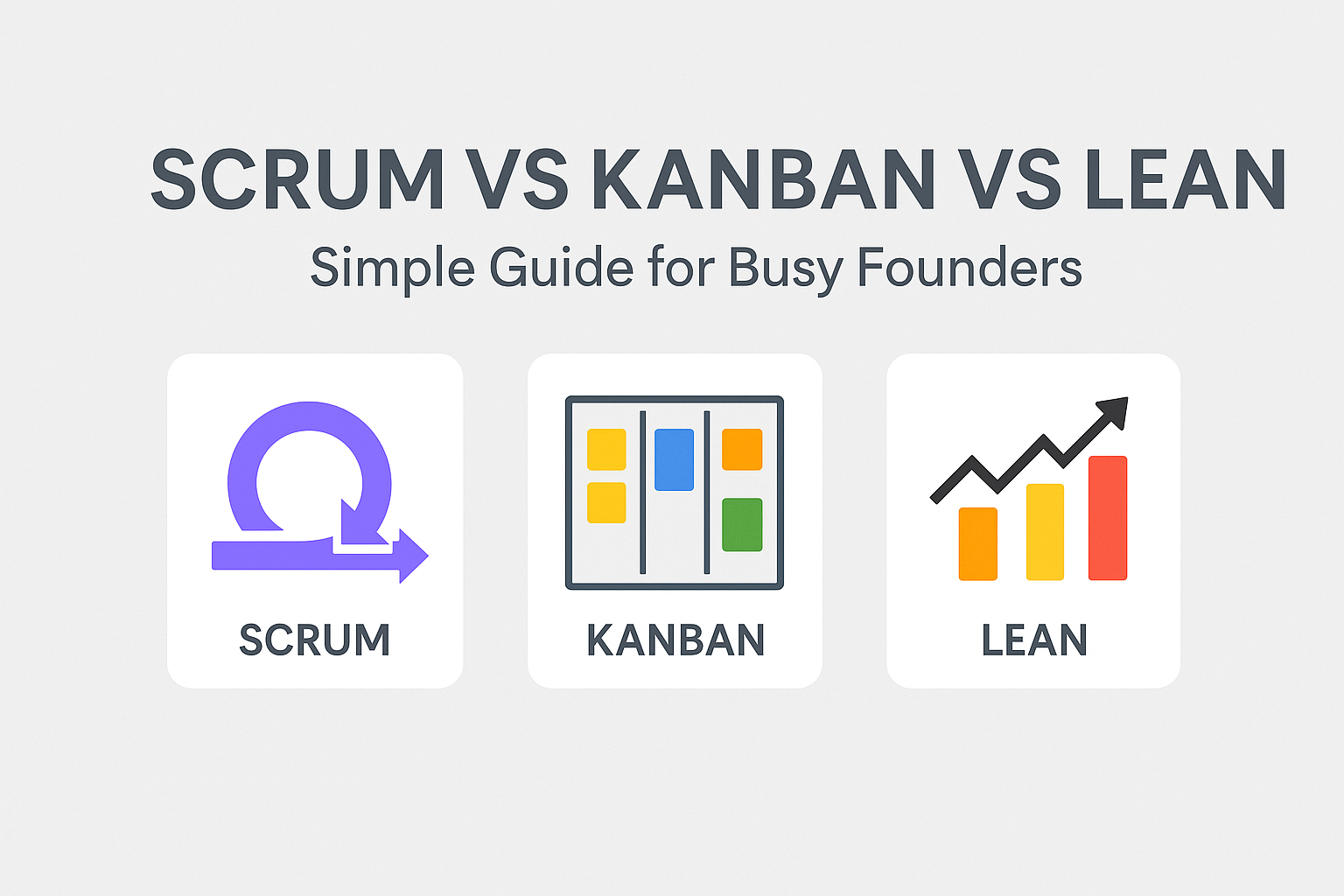
4. The Easiest Explanation of All Three (Founder Snapshot)
Scrum
“We work in weekly cycles.”
Goal: Predictability & focus.
Kanban
“We keep work flowing continuously.”
Goal: Flexibility & speed.
Lean
“We remove anything that slows us down.”
Goal: Efficiency & improvement.
5. Real-World Scenarios (So You Know What Fits YOU)
Scenario 1: You run an agency
Ongoing client requests? → Kanban
Marketing campaigns? → Scrum
Fixing internal processes? → Lean
Scenario 2: You run a product startup
Feature development? → Scrum
Bug fixes & support? → Kanban
Improving delivery speed? → Lean
Scenario 3: You run construction operations
Daily site tasks? → Kanban
Design/engineering phases? → Scrum
Removing delays & waste? → Lean
Scenario 4: You run a coaching business
Client progress tasks? → Kanban
Course creation? → Scrum
Improving your program flow? → Lean
Scenario 5: You run a talent/model agency
Bookings? → Kanban
Campaign planning? → Scrum
Improving approval pipelines? → Lean
6. Which One Should YOU Choose? (Decision Guide)
Choose Scrum if:
✓ You want weekly planning
✓ You want deadlines
✓ You want structure
✓ You run milestone-based projects
Choose Kanban if:
✓ You receive unpredictable work
✓ You need flexibility
✓ You hate long meetings
✓ You need real-time visibility
Choose Lean if:
✓ Your team works hard but output is slow
✓ Work gets stuck or delayed
✓ You want long-term efficiency
✓ You want smoother operations
7. The Best Approach for 2025 Teams (Most Founders Choose This)
- Kanban for day-to-day work
- Scrum for bigger initiatives
- Lean for process improvement**
This hybrid approach gives:
✔ Structure
✔ Flexibility
✔ Efficiency
✔ Scalability
8. Final Takeaway for Busy Founders
You don’t need to master Agile. You just need the right work management style for your business.
• If you want predictable weekly execution, choose Scrum.
• If you want continuous flow and flexibility, choose Kanban.
• If you want fewer delays and smoother operations, choose Lean.
The right system will reduce chaos, improve team performance, and help your business scale with fewer surprises.